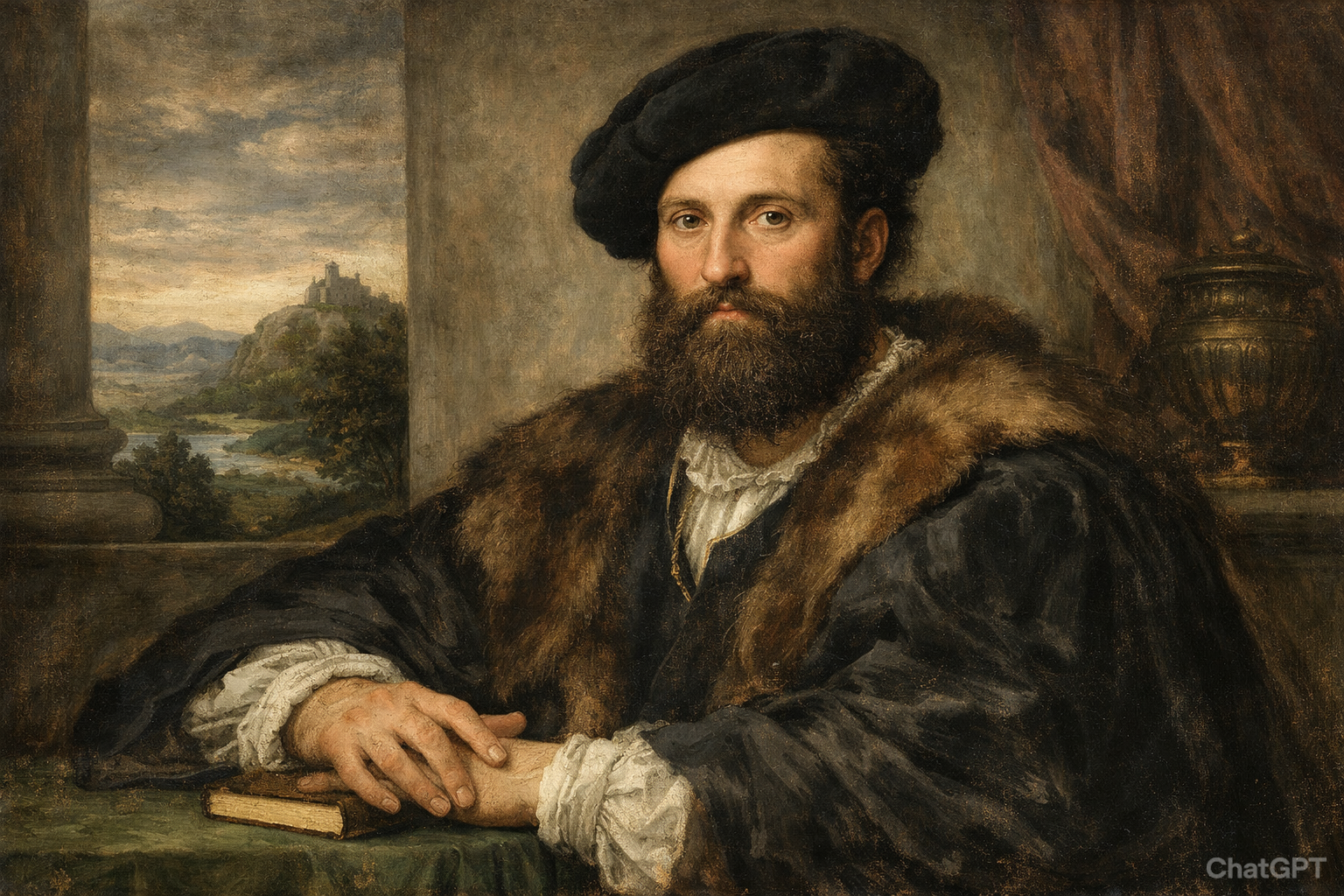
Baldassare Castiglioni: The Architect of Renaissance Courtly Ideals
The Italian Renaissance reshaped Europe’s intellectual, artistic, and social landscapes, producing figures whose influence extended far beyond their own lifetimes. Among these influential personalities stands Baldassare Castiglioni, a diplomat, soldier, and writer whose work captured the spirit of a transformative era. His legacy rests not merely on his political service but on his remarkable contribution to literature, particularly through a single masterpiece that defined the ideals of cultivated behavior for generations. By articulating a vision of refinement, balance, and moral responsibility, he became one of the most significant voices of Renaissance humanism.
In an age characterized by rapid cultural development, city-state rivalries, and renewed interest in classical antiquity, Castiglioni provided a blueprint for conduct that resonated across Europe. His ideas transcended social boundaries and shaped courtly culture from Italy to England. Understanding Baldassare Castiglioni requires exploring his life, intellectual influences, and enduring impact on European thought.
Early Life and Education
Baldassare Castiglioni was born in 1478 in the Duchy of Mantua, a region that thrived culturally under the patronage of noble families. His upbringing in an aristocratic environment provided him with early exposure to classical learning and refined manners. From a young age, he displayed intellectual curiosity and a talent for diplomacy, qualities that would later define his career.
He pursued formal education in Milan and later at the University of Padua, where he studied humanities and Latin literature. These formative years immersed him in the humanist tradition, which emphasized the study of classical texts and the cultivation of moral virtue. Renaissance humanism profoundly influenced his worldview, encouraging a harmonious development of intellect and character.
Service in the Courts of Italy
Castiglioni’s professional life unfolded within the intricate political landscape of Italian courts. He served the Gonzaga family in Mantua before moving to Urbino, where he joined one of the most sophisticated courts of the period. The court of Urbino, under Duke Guidobaldo da Montefeltro and later Francesco Maria della Rovere, was renowned for its patronage of art and literature.
During his years in Urbino, Baldassare Castiglioni engaged with prominent artists, scholars, and statesmen. This vibrant environment inspired his reflections on the qualities required of an ideal courtier. His diplomatic assignments also took him to Spain and Rome, broadening his cultural perspective and strengthening his understanding of European politics.
In 1524, he was appointed papal nuncio to Spain, serving under Pope Clement VII. His diplomatic mission coincided with turbulent times, including the Sack of Rome in 1527. Although criticized by some contemporaries for failing to prevent the catastrophe, Castiglioni defended his actions with dignity and continued to uphold his principles of honor and moderation.
The Book of the Courtier: A Literary Milestone
The enduring fame of Baldassare Castiglioni rests primarily on his masterpiece, Il Libro del Cortegiano (The Book of the Courtier), first published in 1528. Structured as a dialogue set in the court of Urbino, the work explores the attributes of the perfect courtier and lady. Through elegant conversation among fictionalized versions of real historical figures, Castiglioni presents a comprehensive guide to noble conduct.
The book outlines a delicate balance between grace and discipline, intellect and humility. It emphasizes mastery of arms and letters, fluency in languages, musical talent, and the ability to engage in refined conversation. However, the most celebrated concept introduced by Castiglioni is “sprezzatura,” a term describing effortless grace and the art of concealing effort behind polished performance. This principle became central to Renaissance aesthetics and social behavior.
Unlike rigid moral treatises, The Book of the Courtier conveys its lessons through dialogue, allowing readers to witness the dynamic interplay of ideas. The conversational style enhances its accessibility and demonstrates the importance of eloquence in social life. By blending philosophical reflection with practical advice, Castiglioni created a work that appealed to both scholars and nobles.
The Concept of Sprezzatura
One of the most influential contributions of Baldassare Castiglioni to cultural history is the idea of sprezzatura. Derived from the Italian verb meaning “to disdain,” the term suggests an appearance of effortless mastery. The ideal courtier performs difficult tasks with apparent ease, avoiding ostentation or visible strain.
Sprezzatura extends beyond physical skills to encompass speech, attire, and emotional control. According to Castiglioni, true refinement lies in moderation and subtlety. Excessive display diminishes authenticity, while understated confidence enhances credibility. This philosophy reflected the Renaissance emphasis on balance and harmony, echoing classical ideals of virtue.
The notion of effortless excellence influenced not only courtly manners but also artistic expression. Painters, poets, and musicians sought to embody a natural elegance that concealed labor. In this sense, Castiglioni’s ideas contributed to broader aesthetic developments throughout Europe.
Influence on European Culture
The publication of The Book of the Courtier marked a turning point in European literature. The work was translated into multiple languages, including Spanish, French, and English, spreading its influence across courts and intellectual circles. In England, it shaped the ideals of the Elizabethan gentleman and informed discussions of civility and virtue.
Prominent writers and thinkers drew inspiration from Castiglioni’s principles. His emphasis on eloquence and education resonated with Renaissance educators who sought to cultivate well-rounded individuals. The book also intersected with emerging political thought, as it framed personal conduct as integral to effective governance.
By articulating a model of ethical leadership grounded in self-discipline and cultural literacy, Baldassare Castiglioni provided guidance for an era grappling with shifting power structures. His work bridged the worlds of art, politics, and philosophy, reinforcing the interconnectedness of Renaissance disciplines.
Artistic Connections and Humanist Ideals
Castiglioni maintained close relationships with leading artists of his time, including Raphael, who famously painted his portrait. The image captures the serenity and intelligence that characterized the Renaissance gentleman. Through such collaborations, Castiglioni exemplified the synergy between art and humanism.
Humanist philosophy emphasized the development of moral character alongside intellectual achievement. Castiglioni embraced this ideal, advocating for education that cultivated virtue as well as skill. His vision of courtly life integrated classical wisdom with contemporary realities, demonstrating adaptability without sacrificing ethical foundations.
The Renaissance court functioned as a cultural laboratory where artistic experimentation flourished. Within this setting, Castiglioni observed how refinement and patronage fostered innovation. His writing reflects this dynamic environment, blending admiration for classical antiquity with awareness of modern complexities.
Legacy and Modern Relevance
Centuries after his death in 1529, Baldassare Castiglioni remains a reference point in discussions of leadership, etiquette, and cultural sophistication. While the political structures of Renaissance Italy have long since vanished, the principles articulated in The Book of the Courtier continue to resonate.
In contemporary contexts, the concept of sprezzatura finds echoes in professional environments that value composure and adaptability. Leaders who project calm confidence while managing complex responsibilities embody a modern version of Castiglioni’s ideal. Similarly, the emphasis on interdisciplinary education reflects his belief in balanced personal development.
Academic scholarship continues to examine his work as a lens through which to understand Renaissance identity. Historians explore how his dialogue format reveals social dynamics, while literary critics analyze its rhetorical strategies. This sustained interest underscores the enduring significance of his contributions.
Conclusion
Baldassare Castiglioni stands as a defining figure of the Renaissance, embodying the intellectual vitality and cultural refinement of his era. Through his diplomatic service and literary achievement, he articulated a vision of noble conduct that shaped European society for centuries. His masterpiece, The Book of the Courtier, transcended its historical moment to become a timeless guide to grace, moderation, and ethical leadership.
By integrating classical ideals with contemporary realities, Castiglioni crafted a framework for personal excellence that remains relevant today. His concept of sprezzatura continues to inspire discussions of authenticity and elegance in both artistic and professional spheres. As the Renaissance sought to harmonize intellect and virtue, so too did Baldassare Castiglioni leave a legacy that endures as a testament to the power of cultivated character.