Fraction to Decimal Chart: A Complete Guide for Accurate Conversions
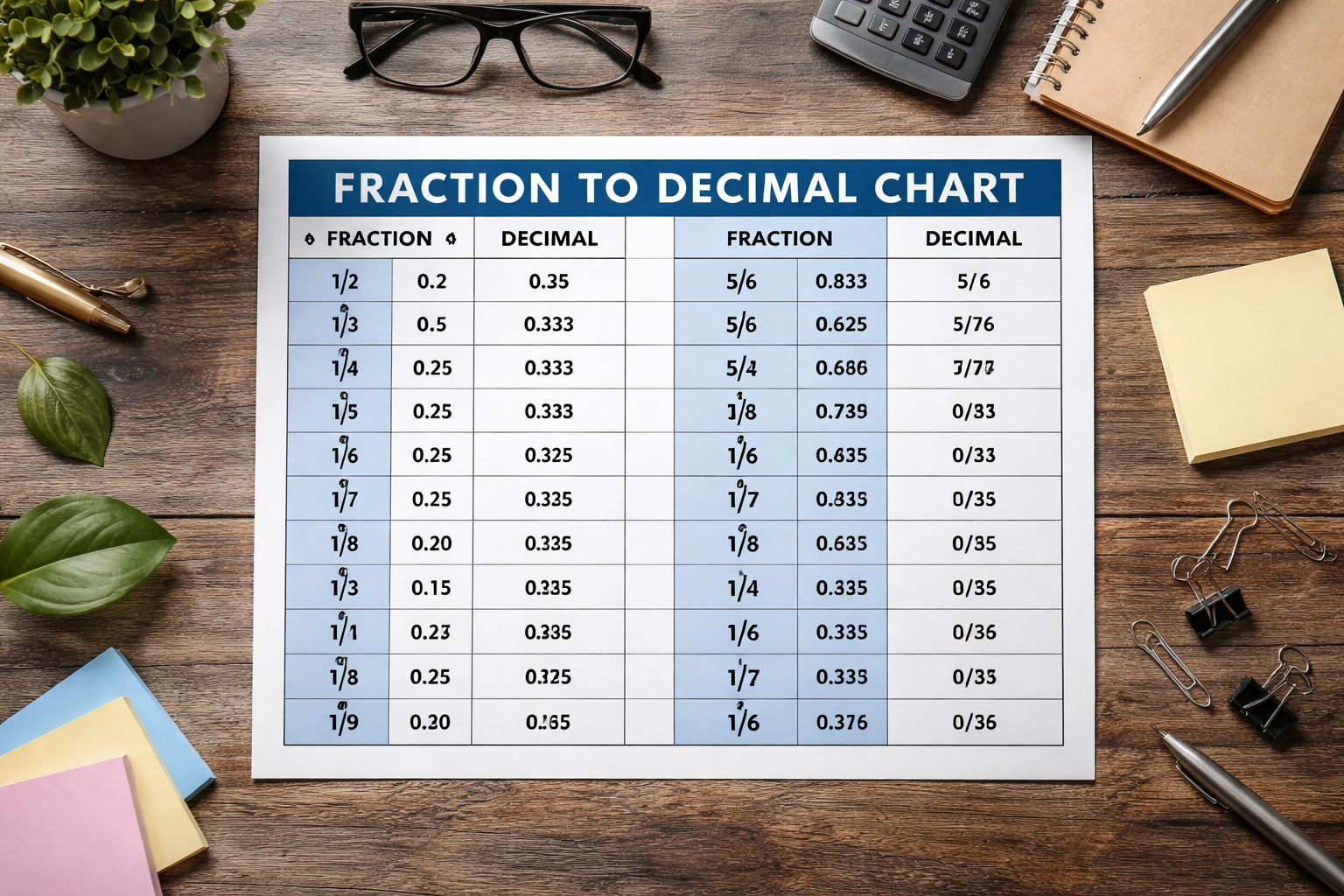
Mathematics forms the foundation of many academic and practical fields, and understanding the relationship between fractions and decimals is an essential skill for students, educators, and professionals alike. One of the most effective tools to simplify this process is the fraction to decimal chart. This chart provides a quick reference for converting common fractions into their decimal equivalents, enhancing accuracy and efficiency in calculations.
Whether you are balancing a budget, working on a scientific calculation, or helping students grasp mathematical concepts, a fraction to decimal chart serves as a reliable guide. By offering a visual and structured representation of fractions alongside their decimal forms, it reduces errors and saves time. This article explores the importance, construction, and practical applications of a fraction to decimal chart, along with tips for its effective use in various scenarios.
Understanding Fractions and Decimals
Before delving into the chart itself, it is important to understand what fractions and decimals represent.
Fractions
A fraction consists of two numbers: the numerator and the denominator. The numerator represents the number of parts taken, while the denominator indicates the total number of equal parts. For example, in the fraction 3/4, three parts out of four are considered. Fractions are commonly used in measurements, ratios, and probabilities.
Decimals
Decimals are another way to represent parts of a whole, using a base-ten system. For example, the fraction 3/4 can be expressed as 0.75 in decimal form. Decimals are often more convenient for calculations and digital applications, especially when performing arithmetic operations or data analysis.
Relationship Between Fractions and Decimals
Every fraction can be converted into a decimal by dividing the numerator by the denominator. Conversely, some decimals can be expressed as fractions, although repeating decimals may require approximation. Understanding this relationship is crucial in fields such as science, finance, and engineering.
What Is a Fraction to Decimal Chart?
It typically includes commonly used fractions, such as halves, thirds, quarters, fifths, and tenths, making it easier to quickly identify the corresponding decimal without performing division.
Structure of the Chart
Most charts are organized in two columns: one for the fraction and one for the decimal. Some charts may also include percentage equivalents for additional context. For example:
| Fraction | Decimal | Percentage |
| 1/2 | 0.5 | 50% |
| 1/3 | 0.333… | 33.33% |
| 1/4 | 0.25 | 25% |
This clear structure allows users to compare fractions and decimals at a glance, which is especially helpful during exams, calculations, and practical problem-solving.
Importance of a Fraction to Decimal Chart
A fraction to decimal chart is more than a simple reference; it offers numerous benefits in both educational and professional contexts.
Enhances Mathematical Understanding
By showing the direct relationship between fractions and decimals, the chart helps learners understand how parts of a whole can be represented in different forms. This visual approach reinforces conceptual understanding.
Saves Time in Calculations
Instead of performing manual division for every conversion, users can quickly consult the chart. This improves efficiency, especially when dealing with multiple calculations or complex problems.
Reduces Errors
Manual conversion can lead to mistakes, particularly with repeating or non-terminating decimals. Using a chart minimizes these errors by providing accurate references.
Useful Across Disciplines
From accounting and engineering to statistics and cooking, understanding fractions and decimals is essential. A fraction to decimal chart provides a universal tool that can be applied in multiple scenarios.
How to Use a Fraction to Decimal Chart
Using a fraction to decimal chart is straightforward but requires understanding how to read and apply it effectively.
Identifying the Fraction
Locate the fraction you wish to convert in the chart’s first column. Ensure the fraction is in its simplest form for accurate reference.
Reading the Decimal Equivalent
Once the fraction is identified, read across the row to find its decimal equivalent. This allows for quick and accurate conversion without additional calculations.
Applying the Decimal
Use the decimal value in your calculations, whether in arithmetic operations, measurements, or data analysis. For repeating decimals, decide whether rounding is necessary based on the required precision.
Creating Your Own Fraction to Decimal Chart
While ready-made charts are available, creating a personalized chart can enhance learning and retention.
Selecting Common Fractions
Start by listing the fractions you frequently encounter. Focus on halves, thirds, fourths, fifths, eighths, tenths, and other practical fractions.
Performing Conversions
Convert each fraction into its decimal form using division. For example, divide the numerator by the denominator.
Organizing the Chart
Create a table with clear headings: Fraction, Decimal, and optionally Percentage. Use consistent formatting for readability.
Updating as Needed
As you encounter new fractions in different contexts, add them to your chart. Over time, it becomes a comprehensive personal reference tool.
Practical Applications of a Fraction to Decimal Chart
The utility of a fraction to decimal chart extends beyond classrooms.
Education
Teachers and students use charts to simplify lessons and homework assignments. They are particularly helpful for visual learners who benefit from seeing fractions and decimals side by side.
Finance
Financial calculations often require decimal representation of fractions, such as interest rates, loan calculations, or stock prices. Charts provide quick and accurate references.
Cooking and Baking
Recipes frequently include fractional measurements. Converting fractions to decimals helps when scaling recipes or using digital measuring tools.
Engineering and Construction
Precise measurements are essential in technical fields. Converting fractions to decimals ensures accuracy in dimensions, tolerances, and calculations.
Tips for Effective Use
To maximize the benefits of a fraction to decimal chart, follow these best practices:
Keep the Chart Accessible
Whether printed or digital, ensure the chart is readily available for quick reference.
Use Simplified Fractions
Simplify fractions before consulting the chart to avoid confusion and errors.
Round Decimals Appropriately
For repeating decimals, determine the level of precision needed and round accordingly.
Practice Regularly
Use the chart consistently in exercises and real-world scenarios to reinforce understanding and improve speed.
Common Mistakes to Avoid
Even with a chart, users may encounter errors if they do not follow proper procedures.
Ignoring Repeating Decimals
Some fractions convert into repeating decimals. Failing to account for this can affect accuracy.
Misreading Fractions
Ensure the fraction is correctly identified and in its simplest form before using the chart.
Overreliance
While charts are helpful, understanding the process of converting fractions to decimals manually is still important for deeper comprehension.
Advanced Applications
For those who frequently deal with fractions, decimals, and percentages, a fraction to decimal chart can be expanded for advanced applications.
Scientific Calculations
Use the chart to quickly convert fractional values into decimals for formulas and calculations in physics, chemistry, and other sciences.
Statistical Analysis
Decimal equivalents of fractions are essential for computing probabilities, ratios, and percentages in data analysis.
Programming and Coding
Developers often need decimal representations of fractions in algorithms and financial software. Having a chart as a reference can streamline coding tasks.
Conclusion
A fraction to decimal chart is an invaluable tool that simplifies mathematical conversions, enhances accuracy, and saves time. By providing a clear visual representation of common fractions and their decimal equivalents, it supports learning, practical applications, and professional tasks across various fields.
Understanding how to read, use, and even create your own chart ensures that you can apply fractions and decimals confidently and accurately. From classrooms to kitchens, financial offices, and engineering labs, the fraction to decimal chart remains a fundamental resource for anyone working with numbers. By mastering its use, individuals can achieve greater precision, efficiency, and comprehension in their mathematical and practical endeavors.