Understanding the Freygish Scale: Origins, Structure, and Musical Significance
The freygish scale holds a unique and expressive place in the world of music theory. Known for its dramatic, emotive sound, this scale immediately evokes feelings of tension, longing, and cultural depth. It appears most prominently in Jewish music traditions but has also found a lasting home in jazz, rock, metal, and contemporary world music. Its ability to blend familiarity with exoticism makes it a compelling subject for musicians, composers, and theorists alike. This article explores the freygish scale in detail, tracing its origins, examining its structure, and explaining why it continues to influence modern music across genres.
Historical and Cultural Origins of the Freygish Scale
Roots in Jewish Musical Tradition
The freygish scale is deeply rooted in Ashkenazi Jewish music, particularly in Klezmer and synagogue chant traditions. The term “freygish” itself is derived from Yiddish and loosely connected to the Phrygian mode, though the scale has its own distinct character. Historically, it was used to convey solemnity, spirituality, and emotional intensity during religious ceremonies and communal gatherings. Over time, it became a defining sound of Jewish folk expression, instantly recognizable even to listeners unfamiliar with its theoretical background.
Connections to Middle Eastern and Eastern European Music
While closely associated with Jewish music, the freygish scale also reflects broader musical exchanges across Eastern Europe and the Middle East. Similar scalar patterns appear in Arabic maqams, Turkish modes, and Balkan folk music. These shared characteristics suggest centuries of cultural interaction, migration, and adaptation. As a result, the freygish scale carries a multicultural identity that transcends a single tradition, making it both historically rich and globally resonant.
Theoretical Structure of the Freygish Scale
Interval Pattern and Scale Formula
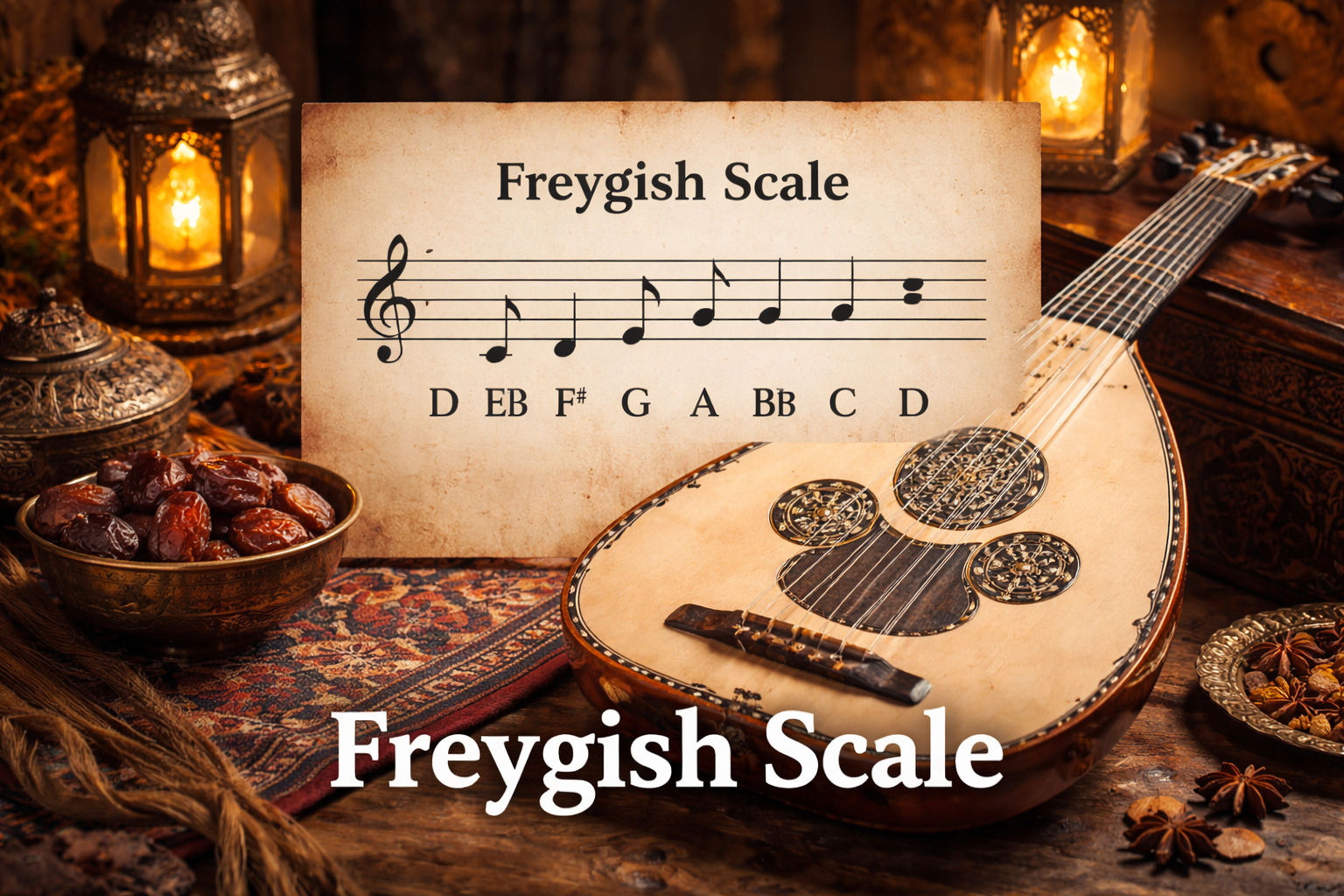
From a theoretical perspective, the freygish scale is often described as a variation of the Phrygian mode with a raised third. In terms of intervals, it follows a distinctive pattern that gives it its unmistakable sound. When analyzed step by step, the scale creates a strong contrast between minor and major tonal elements. This contrast is responsible for its dramatic quality and emotional pull, allowing it to sound both dark and vibrant at the same time.
Comparison with Related Scales
The freygish scale is sometimes confused with harmonic minor or Phrygian dominant scales due to overlapping notes. However, its tonal center and functional use set it apart. Unlike harmonic minor, which emphasizes classical resolution, the freygish scale often sustains tension rather than resolving it. Compared to standard Phrygian, the raised third introduces a brighter, almost triumphant color. These subtle differences are essential for understanding how the scale functions in performance and composition.
Emotional Character and Musical Expression
Why the Freygish Scale Sounds So Distinctive
One of the most striking aspects of the freygish scale is its emotional intensity. The half-step movement at the beginning creates immediate tension, while the augmented interval between the second and third degrees adds an exotic flavor. This combination produces a sound that feels ancient, spiritual, and emotionally charged. Musicians often describe it as expressive, mournful, or even mystical, making it ideal for storytelling through music.
Use in Melody and Improvisation
Melodically, the freygish scale encourages expressive phrasing and ornamentation. In traditional contexts, performers often use slides, trills, and microtonal inflections to enhance its emotional impact. In modern genres, improvisers use the scale to create solos that stand out due to their unusual tonal color. Its flexibility allows it to function both as a central melodic framework and as a contrasting element within more conventional harmonic settings.
The Freygish Scale in Traditional Music
Role in Klezmer Music
Klezmer music relies heavily on the freygish scale to convey joy, sorrow, and celebration simultaneously. Clarinetists and violinists, in particular, have developed a rich vocabulary of expressive techniques centered around this scale. It often appears in dance tunes, wedding music, and ceremonial pieces, where its emotive power enhances communal experiences. The scale’s ability to communicate complex emotions without words is one reason it remains central to Klezmer performance.
Liturgical and Vocal Applications
In religious contexts, the freygish scale is frequently used in cantorial singing. Its tonal structure supports expressive vocal lines that mirror the emotional depth of sacred texts. Cantors use the scale to emphasize important phrases, drawing listeners into a reflective and spiritual state. This liturgical use reinforces the scale’s association with devotion, tradition, and cultural continuity.
Adoption of the Freygish Scale in Modern Genres
Jazz and Fusion Interpretations
Jazz musicians have long been drawn to the freygish scale for its improvisational potential. Its unusual intervals offer fresh melodic possibilities that break away from standard major and minor frameworks. In modal jazz and fusion, the scale is often used over dominant chords to create tension and color. This application highlights its adaptability and demonstrates how traditional musical ideas can evolve within contemporary forms.
Rock and Metal Influences
In rock and metal music, the freygish scale is frequently employed to create an exotic or aggressive atmosphere. Guitarists use it to craft riffs and solos that sound intense and unconventional. Its dramatic quality pairs well with distorted tones and driving rhythms, making it a popular choice for artists seeking a distinctive sonic identity. Through these genres, the scale has reached audiences far beyond its traditional roots.
Practical Applications for Musicians
Learning and Practicing the Freygish Scale
For musicians interested in incorporating the freygish scale into their playing, understanding its structure is only the first step. Effective practice involves exploring melodic patterns, sequencing exercises, and improvisational ideas within the scale. Playing it in different keys helps internalize its sound and reveals how it interacts with various harmonic contexts. Over time, familiarity allows musicians to use the scale naturally rather than as a novelty.
Compositional Uses and Harmonic Context
Composers often use the freygish scale to establish a specific mood or cultural reference. It can serve as the foundation for an entire piece or appear briefly to add contrast. Harmonically, it works well over dominant chords and pedal tones, where its tension can be sustained without immediate resolution. Thoughtful use ensures that the scale enhances the music rather than overwhelming it.
Cultural Significance and Modern Relevance
Preservation of Musical Heritage
The continued use of the freygish scale plays an important role in preserving musical heritage. By studying and performing music that features this scale, musicians help maintain a connection to historical traditions and cultural identity. This preservation is not static; it allows for reinterpretation and growth, ensuring that the scale remains relevant in changing musical landscapes.
Global Appeal and Cross-Cultural Exchange
In today’s interconnected world, the freygish scale serves as a bridge between cultures. Its presence in diverse musical styles demonstrates how traditional elements can inspire innovation. As artists experiment with blending genres, the scale’s distinctive sound continues to captivate listeners and encourage cross-cultural appreciation. This global appeal underscores its enduring value.
Conclusion
The freygish scale is far more than a theoretical construct or a niche musical device. It represents centuries of cultural expression, emotional depth, and artistic evolution. From its roots in Jewish tradition to its adoption in modern jazz, rock, and world music, the scale has proven remarkably adaptable and timeless. Its distinctive sound continues to inspire musicians seeking new ways to communicate emotion and identity through music. By understanding and embracing the freygish scale, performers and listeners alike gain access to a rich musical language that speaks across generations and cultures, ensuring its place in the future of global music.