Kanonaki Instrument: History, Design, and Cultural Significance in Eastern Mediterranean Music
The kanonaki instrument occupies a distinctive place in the rich tapestry of Eastern Mediterranean music. With its shimmering tones and intricate playing technique, this plucked string instrument has captivated audiences for centuries. Musicians across Greece, Turkey, and the broader Middle East have embraced its expressive range, making it a cornerstone of traditional and contemporary ensembles alike. Although many listeners may recognize its sound without knowing its name, the kanonaki instrument continues to influence regional music through its melodic versatility and harmonic depth.
Understanding the historical roots, structural design, performance techniques, and cultural significance of this instrument provides valuable insight into the broader musical traditions of the region. This article offers a comprehensive exploration of the kanonaki instrument, highlighting its evolution, craftsmanship, and enduring artistic importance.
Historical Origins and Development
Ancient Foundations
The kanonaki instrument traces its lineage to ancient zither-like instruments that appeared in the Middle East and surrounding regions thousands of years ago. Early civilizations developed stringed instruments that relied on tensioned strings stretched across a resonating body. Over time, these prototypes evolved into more sophisticated designs capable of producing complex tonal systems.
Scholars often associate the kanonaki instrument with the broader family of the qanun, a trapezoidal zither prominent in Ottoman and Arabic music traditions. Historical evidence suggests that variations of this instrument existed during the Byzantine period, when cross-cultural exchanges shaped musical innovation across the Eastern Mediterranean.
Evolution in the Ottoman and Greek Traditions
During the Ottoman era, the qanun became central to court and classical music. In Greece, a localized adaptation known as the kanonaki instrument emerged, reflecting regional scales and performance practices. Musicians incorporated microtonal adjustments to accommodate the modal systems characteristic of Greek and Anatolian music.
The instrument’s presence in urban centers such as Istanbul and Athens contributed to its refinement. Cultural exchange between these cities allowed artisans and performers to experiment with structural modifications, expanding the tonal possibilities of the instrument.
Structural Design and Craftsmanship
Physical Characteristics
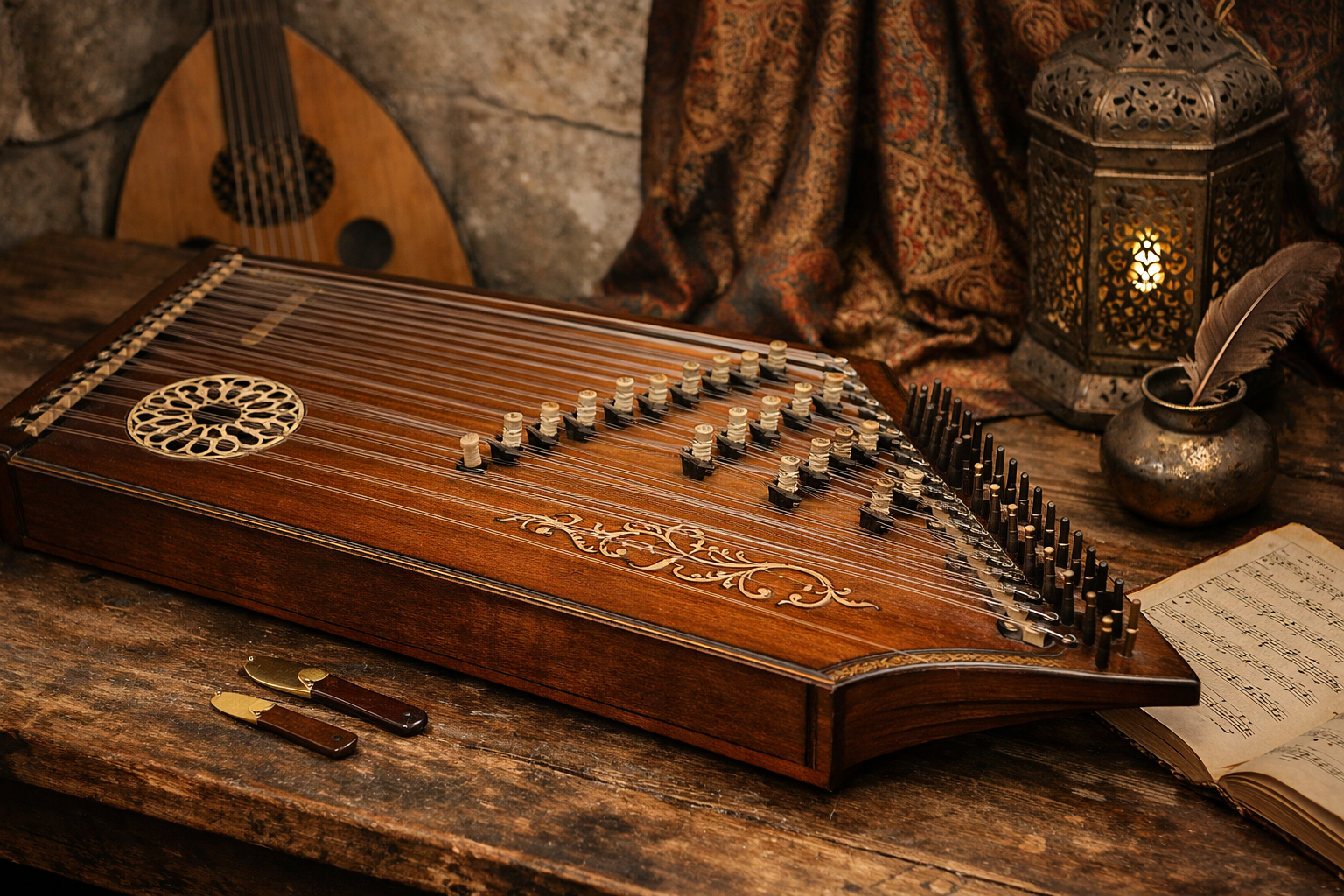
The kanonaki instrument features a flat, trapezoidal wooden body with numerous strings stretched across its soundboard. Depending on the model, it may contain between seventy and eighty strings grouped in courses of three. Each course produces a single pitch, while the grouping enhances resonance and tonal richness.
The instrument rests horizontally, typically on the musician’s lap or on a small table. Its design allows performers to access all strings easily, facilitating rapid melodic passages and ornamentation. The soundboard often includes decorative rosettes that enhance both acoustic quality and visual appeal.
Materials and Construction Techniques
Craftsmen construct the kanonaki instrument from carefully selected woods to optimize resonance. Spruce or cedar commonly forms the soundboard, while harder woods provide structural stability for the frame. Precision in carving and assembly ensures accurate string tension and tonal balance.
One defining feature of the instrument is its system of small levers, known as mandals. These adjustable mechanisms enable performers to alter pitch microtonally. By engaging or disengaging the levers, musicians shift between scales without retuning the entire instrument. This mechanical innovation distinguishes the kanonaki instrument from many Western zithers.
Musical Characteristics and Sound
Tonal Range and Expression
The kanonaki instrument produces a bright, crystalline sound that carries both delicacy and power. Its wide tonal range allows musicians to perform complex melodic lines across multiple octaves. The triple-string configuration enriches the timbre, creating a shimmering effect that blends seamlessly with other traditional instruments.
Players typically wear plectra attached to their index fingers. These picks allow precise articulation while preserving fluidity. Through controlled plucking patterns, performers achieve rapid tremolos and intricate embellishments characteristic of Eastern Mediterranean music.
Role in Modal Music Systems
Unlike Western music, which relies primarily on fixed semitones, many Eastern traditions employ modal systems incorporating microtones. The kanonaki instrument accommodates these subtleties through its lever mechanism. Musicians can shift between modes during performance, enhancing expressive nuance.
This adaptability makes the instrument indispensable in traditional ensembles that feature modal improvisation. Its ability to navigate subtle pitch variations ensures authenticity in both classical and folk repertoires.
Cultural Significance
Presence in Greek Music
In Greece, the kanonaki instrument plays a vital role in genres such as Smyrnaic and rebetiko music. It often accompanies vocals and other instruments, weaving intricate countermelodies that enrich the overall texture. The instrument’s expressive quality complements lyrical themes of longing, nostalgia, and resilience.
Greek composers and performers have preserved the kanonaki instrument as a symbol of cultural continuity. Through festivals, educational programs, and recordings, they maintain its relevance in modern musical contexts.
Influence Across the Middle East
Beyond Greece, the instrument’s relatives remain central to musical traditions in countries such as Turkey, Egypt, and Lebanon. In Ottoman classical music, the qanun served as a foundational instrument within court ensembles. Today, contemporary musicians integrate it into experimental and fusion projects, bridging tradition and innovation.
The widespread presence of the kanonaki instrument and its counterparts underscores a shared musical heritage across diverse cultures.
Performance Techniques and Mastery
Training and Skill Development
Learning to play the kanonaki instrument requires discipline and sensitivity. Students must develop coordination between both hands while mastering modal theory. Teachers emphasize precise finger placement, rhythmic control, and awareness of microtonal intervals.
Because the instrument supports rapid melodic movement, performers invest years refining speed and clarity. Mastery involves balancing technical precision with emotional expression.
Improvisation and Artistic Interpretation
Improvisation holds a central place in Eastern Mediterranean music. Skilled players use the kanonaki instrument to explore modal variations spontaneously. By adjusting levers mid-performance, they create dynamic shifts in mood and intensity.
This improvisational capacity distinguishes accomplished musicians from novices. It reflects a deep understanding of musical structure and cultural tradition.
Modern Adaptations and Global Reach
Integration into Contemporary Music
Modern composers increasingly incorporate the kanonaki instrument into cross-genre collaborations. Jazz, world music, and cinematic compositions benefit from its distinctive tonal color. Recording technology further amplifies its global presence, enabling audiences worldwide to experience its sound.
Musicians based in cultural hubs such as New York City and London experiment with blending traditional instruments into diverse musical frameworks. These collaborations demonstrate the instrument’s adaptability beyond regional boundaries.
Preservation Efforts
Cultural organizations and conservatories promote education programs dedicated to traditional instruments. Workshops, masterclasses, and academic research contribute to sustaining interest in the kanonaki instrument. By documenting performance techniques and craftsmanship methods, scholars ensure that knowledge passes to future generations.
Such preservation efforts reinforce the instrument’s status as both a historical artifact and a living artistic medium.
Conclusion
The kanonaki instrument embodies centuries of musical evolution, craftsmanship, and cultural exchange. From its ancient origins to its role in contemporary performance, it continues to captivate musicians and audiences alike. Its trapezoidal design, microtonal flexibility, and luminous timbre distinguish it within the broader family of stringed instruments.
By examining its historical development, structural features, and artistic applications, one recognizes its enduring value within Eastern Mediterranean music. The kanonaki instrument not only preserves tradition but also inspires innovation across global stages. As musicians continue to explore its expressive capabilities, this remarkable instrument remains a vibrant testament to the power of cultural continuity and artistic excellence.