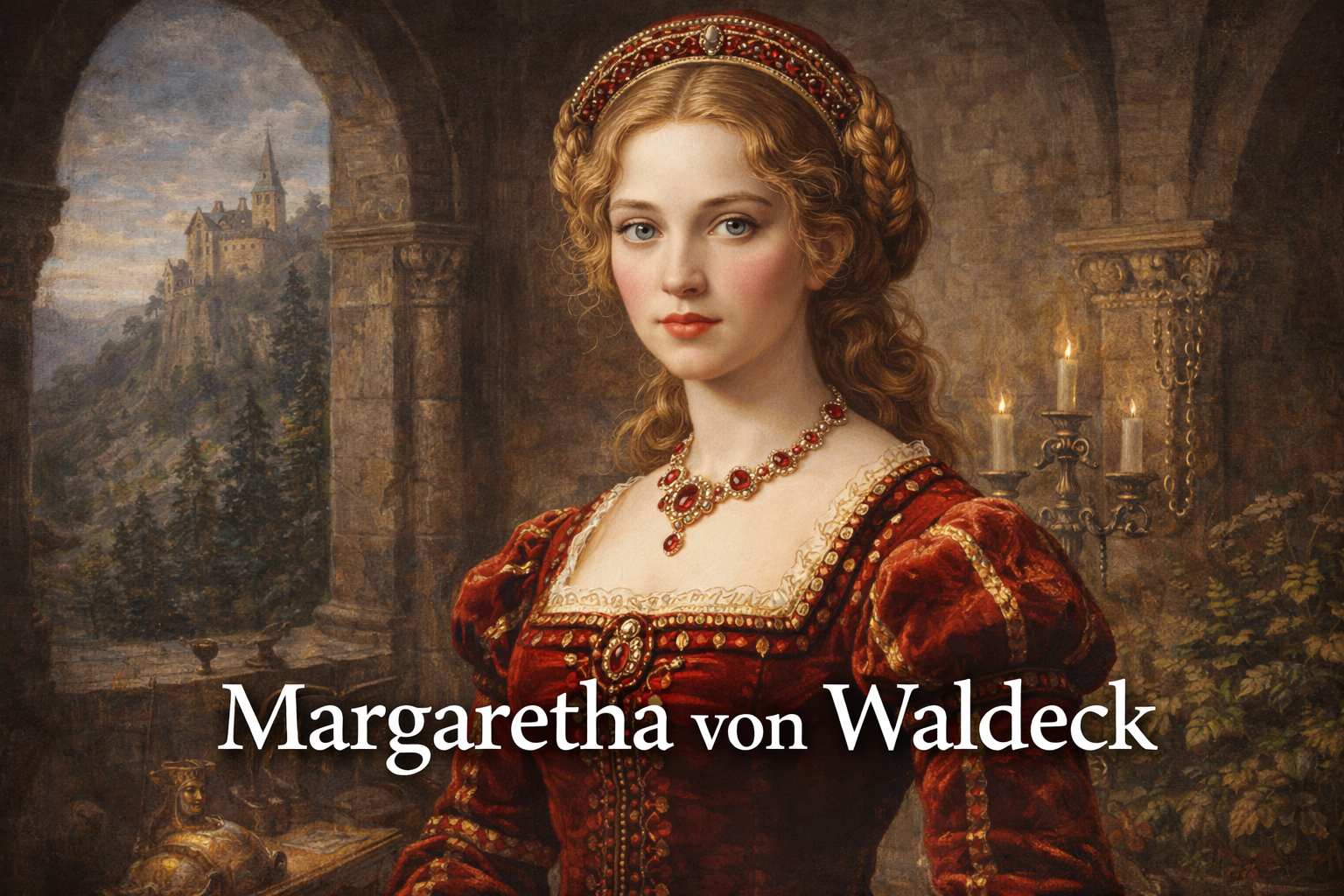
Margaretha von Waldeck: A Historical Figure Between Power, Politics, and Legend
Margaretha von Waldeck remains one of the most intriguing noblewomen of the sixteenth century, a figure whose short life intersected with dynastic ambition, European power politics, and later literary legend. Born into a prominent German noble family during a period of intense political and religious change, Margaretha’s story reflects both the privileges and vulnerabilities of aristocratic women in Renaissance Europe. Although historical records about her life are limited, the surviving accounts reveal a young woman whose personal fate was closely tied to the strategic interests of powerful courts. Over time, her biography has also inspired speculation and myth, blurring the line between documented history and cultural memory. This article explores the life, historical context, and lasting significance of Margaretha von Waldeck, presenting a comprehensive and balanced account grounded in historical understanding.
Early Life and Noble Origins
Margaretha von Waldeck was born in 1533 into the House of Waldeck, a noble family with considerable influence in what is now central Germany. Her father, Philip IV, Count of Waldeck-Wildungen, was a politically active ruler who navigated the complex alliances of the Holy Roman Empire. As a member of the high nobility, Margaretha grew up in an environment shaped by courtly culture, education, and expectations of strategic marriage. From an early age, her life path was less a matter of personal choice and more a reflection of dynastic responsibility.
Her upbringing would have included instruction in religion, etiquette, and languages, all considered essential for noblewomen destined for court life. Education for women of her rank was designed to prepare them to represent their families with dignity and to forge alliances through marriage. Margaretha’s youth coincided with the Protestant Reformation, a movement that significantly affected German principalities. The House of Waldeck was among those influenced by religious reform, adding another layer of political complexity to her family background.
The Political Landscape of Sixteenth-Century Europe
To understand Margaretha von Waldeck, it is essential to consider the broader political environment of her time. Sixteenth-century Europe was marked by intense rivalry among ruling houses, particularly between the Habsburg dynasty and other noble families seeking influence within the Holy Roman Empire. Marriages were critical tools in these struggles, often serving as diplomatic agreements rather than personal unions.
Women of noble birth played a central but constrained role in this system. Their value lay in their ability to strengthen alliances, secure peace, or increase a family’s standing. Margaretha’s life unfolded within this framework, where individual aspirations were subordinate to political necessity. Courts such as those in Brussels, Vienna, and Madrid functioned as centers of power, and a young noblewoman’s presence there was rarely accidental.
Life at the Court of Mary of Hungary
One of the most significant chapters in Margaretha von Waldeck’s life was her time at the court of Mary of Hungary, the sister of Emperor Charles V and governor of the Habsburg Netherlands. Margaretha was sent to Brussels as a teenager, a move that reflected her family’s ambitions to strengthen ties with the Habsburgs. Life at this court exposed her to the highest levels of European politics and culture.
At court, Margaretha was noted for her beauty and refinement, qualities that attracted attention from influential figures. Historical accounts suggest that she became romantically involved with Prince Philip of Spain, the future King Philip II. While the extent and seriousness of this relationship remain debated among historians, contemporary sources indicate that Margaretha’s presence made a strong impression. Such an association, whether formal or informal, would have been politically sensitive, given Philip’s dynastic responsibilities.
Romantic Speculation and Political Reality
The reported relationship between Margaretha von Waldeck and Prince Philip illustrates the tension between personal emotion and political obligation. Philip, as heir to a vast empire, was expected to contract a marriage that would serve strategic interests, particularly those of the Habsburg dynasty. Any personal attachment that did not align with these goals was unlikely to be sanctioned.
Margaretha’s status, while noble, did not match the political weight required for a royal marriage. As a result, even the suggestion of a romantic connection placed her in a precarious position. For women at court, admiration could quickly become a liability, especially when it intersected with succession politics. This dynamic highlights the limited agency available to noblewomen, whose reputations and futures were closely monitored and controlled.
Illness, Death, and Unanswered Questions
Margaretha von Waldeck’s life came to a sudden and tragic end in 1554, when she died at the age of twenty-one. Officially, her death was attributed to illness, a common explanation in an era when medical knowledge was limited. However, rumors of poisoning emerged soon after, fueled by the political tensions surrounding her alleged relationship with Prince Philip.
While there is no definitive evidence to support claims of foul play, the persistence of these rumors reflects contemporary anxieties about court intrigue and the perceived expendability of women in power struggles. Poisoning was a common fear in Renaissance courts, often invoked to explain unexpected deaths. Margaretha’s early demise thus became part of a broader narrative about danger and deception within elite circles.
Margaretha von Waldeck and Historical Interpretation
From a historian’s perspective, Margaretha von Waldeck represents both a documented individual and a symbolic figure. The scarcity of primary sources makes it difficult to reconstruct her life in detail, yet this absence has also invited interpretation and speculation. Scholars generally agree that her story illustrates the vulnerability of noblewomen whose lives were shaped by forces beyond their control.
Her experience at the Habsburg court, combined with her untimely death, has been analyzed as an example of how personal identity could be overshadowed by political function. Margaretha’s legacy, therefore, is not defined by achievements in governance or culture, but by what her life reveals about the social structures of her time.
Connection to Folklore and Literary Legend
One of the most enduring aspects of Margaretha von Waldeck’s legacy is her association with later folklore, particularly the story of Snow White. Some researchers have suggested that her life may have influenced early versions of the tale, pointing to similarities such as a young noblewoman, courtly intrigue, and a premature death. While this theory remains speculative and contested, it demonstrates how historical figures can be absorbed into cultural imagination.
Whether or not Margaretha directly inspired literary tradition, the comparison underscores how her story resonates beyond archival records. The blending of fact and legend reflects a human tendency to seek narrative meaning in historical lives, especially those marked by beauty, tragedy, and mystery.
The Role of Women in Renaissance Power Structures
Margaretha von Waldeck’s biography provides valuable insight into the broader role of women in Renaissance Europe. Noblewomen were essential to the functioning of dynastic politics, yet their contributions were often indirect and unacknowledged. Their movements, marriages, and even personal relationships were subject to strategic calculation.
Despite these constraints, women like Margaretha navigated complex social environments that required intelligence, adaptability, and resilience. Although history has preserved only fragments of her voice, her experiences highlight the gendered realities of power in early modern Europe. Understanding her life helps modern readers appreciate both the limitations imposed on women and the subtle forms of influence they exercised.
Historical Significance and Modern Interest
Interest in Margaretha von Waldeck has grown in recent decades, driven by interdisciplinary research that combines history, literature, and cultural studies. Modern historians are increasingly attentive to figures who were previously marginalized in traditional narratives. Margaretha’s life, though brief, offers a lens through which to examine themes of gender, power, and representation.
Her story also appeals to a wider audience because it embodies universal elements of youth, ambition, and loss. By situating her biography within its historical context, scholars and readers alike can move beyond romanticized interpretations and gain a more nuanced understanding of her significance.
Conclusion
Margaretha von Waldeck occupies a distinctive place in European history, not because she wielded overt political power, but because her life reveals the intricate dynamics of noble society in the sixteenth century. Born into privilege yet constrained by expectation, she became a participant in high-level court politics at a young age. Her rumored romance, sudden death, and subsequent association with legend have ensured that her name endures beyond the limited documentation of her era.
By examining Margaretha’s life with historical care, it becomes clear that her true importance lies in what she represents rather than in any single documented event. She stands as a reminder of the human dimension behind dynastic politics and of the many lives shaped, and sometimes cut short, by the demands of power. Margaretha von Waldeck’s story, grounded in history yet enriched by cultural memory, continues to invite reflection on the complex relationship between individual destiny and historical forces.