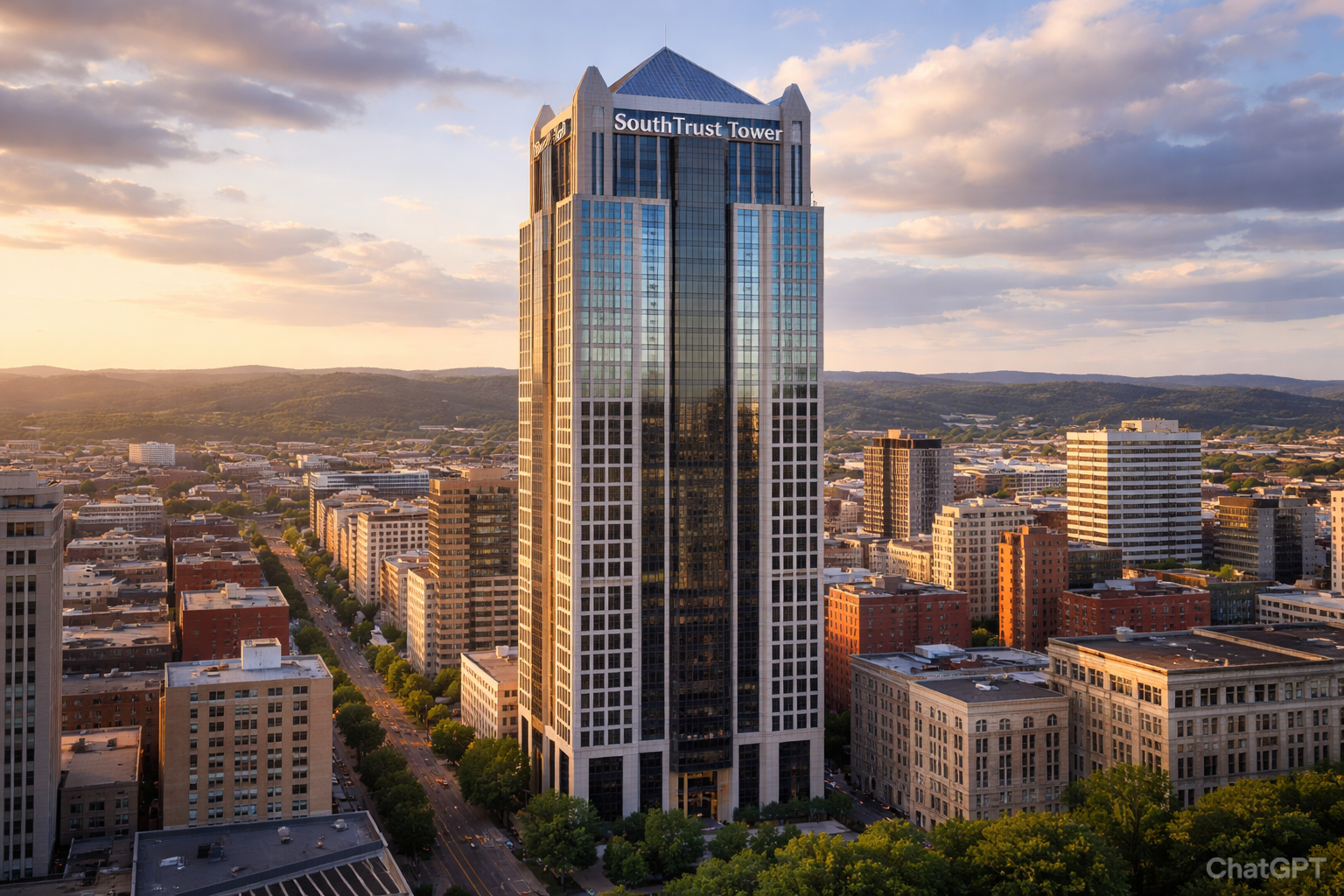
SouthTrust Tower: A Landmark of Corporate Legacy and Urban Identity
In the evolving skyline of Birmingham, Alabama, few structures have embodied corporate ambition and architectural confidence as distinctly as SouthTrust Tower. Rising prominently above the city’s central business district, this high-rise building has long served as a visual anchor and a symbol of economic growth. From its origins as a headquarters for a major regional bank to its transformation under new ownership and branding, the tower reflects the broader narrative of urban development in the American South.
The story of SouthTrust Tower is not merely about bricks, steel, and glass. It is about strategic corporate expansion, architectural design choices that define a city’s silhouette, and the adaptive reuse of commercial real estate in a changing financial landscape. By examining its history, design, economic significance, and cultural presence, one gains a deeper understanding of how a single building can influence the identity of an entire downtown district.
Historical Background of SouthTrust Tower
The Rise of SouthTrust Corporation
SouthTrust Tower was originally constructed as the headquarters for SouthTrust Corporation, a banking institution that played a crucial role in shaping the financial services sector in the southeastern United States. Founded in Birmingham, the company grew steadily through acquisitions and regional expansion, becoming one of the most influential banks in the area by the late twentieth century.
As SouthTrust Corporation expanded its operations, the need for a modern, centralized headquarters became apparent. The decision to build a signature tower in downtown Birmingham was both practical and symbolic. It provided the necessary office space for corporate functions while also projecting strength and stability to clients, investors, and the broader community.
Construction and Urban Context
The tower was completed in the late 1980s during a period of renewed confidence in Birmingham’s commercial sector. Its construction marked a turning point in the revitalization of the downtown area. At a time when many American cities were grappling with suburban flight and economic shifts, the emergence of a new high-rise signaled investment and long-term commitment to the urban core.
Located strategically in the heart of the business district, SouthTrust Tower became a focal point for professional services, financial institutions, and legal firms. Its presence encouraged additional commercial development in surrounding blocks, reinforcing downtown Birmingham as the economic engine of the region.
Architectural Design and Structural Features
A Distinctive Profile
SouthTrust Tower’s architectural design reflects the late twentieth-century corporate aesthetic, combining functionality with a commanding visual presence. The building’s vertical lines and carefully proportioned facade create a sense of upward momentum, drawing the eye toward its upper levels.
The structure’s materials, primarily glass and light-colored stone balance transparency and solidity. Large windows allow natural light to permeate office spaces, while the exterior conveys durability and permanence. This duality mirrors the values associated with financial institutions: openness to clients combined with institutional strength.
Interior Layout and Modernization
Inside, the tower was designed with efficiency and adaptability in mind. Open office floors allow for reconfiguration as tenant needs evolve. Conference rooms, executive suites, and support facilities were integrated into the initial design, ensuring the building could accommodate both corporate headquarters operations and multi-tenant arrangements.
Over the years, modernization efforts have upgraded building systems, including climate control, telecommunications infrastructure, and security technologies. These updates have enabled the property to remain competitive in a market where tenants expect advanced digital connectivity and sustainable energy practices.
Transition and Rebranding
Acquisition by Wells Fargo
A pivotal chapter in the building’s history occurred when SouthTrust Corporation was acquired by Wells Fargo in 2004. This acquisition marked the end of SouthTrust as an independent entity and ushered in a new era for the tower.
Following the merger, the building was rebranded as Wells Fargo Tower. While the name changed, the structure’s role in the city’s skyline remained intact. The rebranding reflected broader trends in banking consolidation, where regional institutions became part of national financial networks.
Economic Implications
The transition did not diminish the building’s importance. Instead, it underscored Birmingham’s continued relevance as a financial hub within the Southeast. Wells Fargo maintained a significant presence in the tower, ensuring that it remained a center for banking and professional services.
This shift also illustrated how commercial real estate can adapt to corporate restructuring. The physical infrastructure of SouthTrust Tower proved flexible enough to support new branding and operational models without losing its architectural identity.
SouthTrust Tower and the Birmingham Skyline
A Defining Landmark
In the context of Birmingham, SouthTrust Tower stands as one of the most recognizable buildings in the skyline. Its height and design set it apart from surrounding structures, making it visible from multiple vantage points across the city.
For residents and visitors alike, the tower functions as a navigational landmark. It anchors the downtown area and contributes to the visual cohesion of the urban core. Photographs of Birmingham frequently feature the tower, underscoring its symbolic value.
Influence on Urban Development
The presence of SouthTrust Tower helped stimulate additional commercial investment in adjacent properties. High-profile office buildings often serve as catalysts for surrounding retail, hospitality, and residential projects. In Birmingham’s case, the tower reinforced confidence in the viability of downtown office space.
As urban planning increasingly emphasizes mixed-use development, the tower’s continued operation demonstrates how legacy office buildings can coexist with newer residential and entertainment venues. Its integration into a broader urban ecosystem highlights the importance of thoughtful city planning.
Economic and Corporate Significance
Employment and Professional Services
At its peak as the headquarters of SouthTrust Corporation, the tower housed thousands of employees engaged in banking, finance, legal services, and administrative support. This concentration of professional activity generated substantial economic benefits for the city.
Even after corporate consolidation, the building continues to host a range of tenants. Law firms, financial advisors, and corporate offices occupy its floors, maintaining steady employment opportunities and contributing to local tax revenues.
Symbol of Financial Stability
For decades, SouthTrust Tower represented institutional reliability. Its prominent signage and commanding height communicated financial strength to clients and investors. In an industry where perception matters, the building’s physical presence reinforced the credibility of its occupants.
This symbolic dimension persists despite rebranding. The tower remains associated with major financial institutions, ensuring its ongoing relevance within Birmingham’s business community.
Adaptation to Contemporary Trends
Sustainability and Energy Efficiency
Modern commercial buildings face increasing pressure to adopt sustainable practices. SouthTrust Tower has undergone updates aimed at improving energy efficiency and reducing operational costs. These measures include upgraded lighting systems, improved insulation, and advanced HVAC technologies.
Such enhancements not only lower environmental impact but also attract tenants who prioritize corporate responsibility. As environmental standards continue to evolve, buildings like SouthTrust Tower must adapt to remain competitive.
Flexible Workspace Solutions
The shift toward hybrid work models has transformed office space requirements. Large corporate headquarters are now reimagining their layouts to accommodate flexible schedules and collaborative environments.
SouthTrust Tower’s adaptable floor plans allow property managers to respond to these changes. By offering customizable office configurations, the building aligns with contemporary workplace expectations while preserving its structural integrity.
Cultural and Community Impact
Civic Identity
Beyond its economic function, SouthTrust Tower contributes to Birmingham’s civic identity. It appears in marketing materials, postcards, and media coverage that depict the city’s skyline. As a result, it plays a role in shaping external perceptions of Birmingham as a modern, forward-looking urban center.
Public Engagement
While primarily a commercial property, the tower’s ground-level presence influences pedestrian experience. Retail spaces and public-facing entrances enhance street activity, fostering a sense of accessibility within the business district.
By maintaining an active and inviting facade, the building supports downtown vibrancy and contributes to the broader urban atmosphere.
The Legacy of SouthTrust Tower
A Reflection of Corporate Evolution
The narrative of SouthTrust Tower mirrors broader trends in American finance, including regional bank growth, corporate consolidation, and brand transformation. Its transition from a dedicated headquarters to a multi-tenant office building under new ownership exemplifies adaptability in a dynamic market.
Enduring Architectural Presence
Despite changes in name and corporate affiliation, the physical structure remains a constant. Its design continues to define Birmingham’s skyline, offering continuity amid economic shifts. The tower stands as a testament to strategic investment in durable, high-quality construction.
Conclusion
SouthTrust Tower represents far more than a former banking headquarters. It embodies decades of economic ambition, architectural vision, and urban transformation. From its origins with SouthTrust Corporation to its rebranding under Wells Fargo, the tower has adapted to shifting corporate landscapes while maintaining its status as a landmark.
As Birmingham continues to evolve, the tower remains a symbol of resilience and progress. Its enduring presence in the city’s skyline underscores the lasting impact of thoughtful design and strategic development. By understanding the history and significance of SouthTrust Tower, one gains insight into the broader story of regional growth, corporate change, and urban identity in the American South.